
AI and the future of survey research: CESSDA at WAPOR 2026
How is artificial intelligence changing the way we collect, analyse and preserve survey data? This was among the central questions discussed at the 79th Annual Conference of the World Association for Public Opinion Research (WAPOR), held in Mexico City, Mexico, on 26–29 October 2026.
The conference brought together 330 participants from 56 countries to exchange knowledge, discuss methodological developments and explore the challenges facing public opinion research.
Representatives from several CESSDA Service Providers attended the conference, contributing to discussions on survey data quality, artificial intelligence and international research collaboration.
Survey research in a changing world
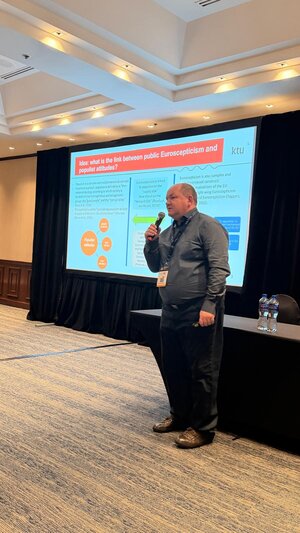 Under the theme Public Opinion Research in an Emerging Multipolar World Order, the conference explored how political, technological and societal changes affect the way public opinion is measured and understood.
With 56 sessions and more than 250 oral and poster presentations, the programme covered topics ranging from cross-cultural research and survey methodology to the growing influence of artificial intelligence.
“Survey data remain a cornerstone of comparative social science, allowing researchers to study attitudes, behaviours and societal developments across countries and cultures. However, technological developments are rapidly changing how these data are collected, processed and analysed,” said Vaidas Morkevičius, senior researcher and coordinator at LiDA, CESSDA’s Lithuania Service Provider, who participated in a session on Methodological Innovations and Data Quality in Cross-National Survey Research.
Artificial intelligence and survey data quality
Artificial intelligence was a recurring theme throughout the conference, with several sessions examining both its potential and the challenges it introduces to survey research.
AI is increasingly being used at different stages of the survey lifecycle, from questionnaire design and translation to coding responses, analysing results and even conducting interviews.
One session, The AI-Translation Pipeline: Synthetic, Multilingual, and Quality-Checked Survey Data, explored the use of large language models (LLMs) to generate synthetic survey responses. Discussions also addressed potential data contamination and translation errors when AI tools are applied across different languages.
Another session, Large Language Models for Coding Open-Ended Survey Data, examined how AI-based approaches compare with traditional methods for analysing written survey responses, particularly when dealing with multilingual and culturally nuanced answers.
The programme also included discussions on synthetic media, public attitudes towards AI and the potential need to update international public opinion polling guidelines to reflect developments in internet polling and artificial intelligence.
“These are developments that raise important questions about the quality, transparency and long-term reusability of research data,” said Vaidas.
For survey data to remain FAIR (Findable, Accessible, Interoperable and Reusable), researchers and data repositories increasingly need to document how AI tools have been used. This includes recording data provenance, the versions of AI models used and the quality assurance procedures applied across languages.
Such requirements create new challenges for research data curation, an area where CESSDA and its Service Providers have extensive expertise.
New opportunities for international collaboration
Besides representatives from LiDA, several other CESSDA Service Providers participated in the conference, highlighting the importance of international cooperation in developing reliable methods for collecting, documenting and preserving survey data.
Beyond the methodological discussions, the conference highlighted potential opportunities for closer cooperation between CESSDA, WAPOR, and the international community.
One development of particular interest is WAPOR's Global Report on Important Topics (GRIT) initiative, which aims to provide data for cross-cultural research on issues of global importance.
The initiative has addressed topics including migration (GRIT 1) and global security and peace (GRIT 2).
As WAPOR develops its role as a producer of international survey data, the curation, preservation and reusability of these datasets could provide opportunities for future collaboration with CESSDA.
CESSDA's experience in supporting access to and reuse of social science data, together with the expertise of its national Service Providers, could contribute to making such international research resources available for future studies.
“As AI becomes increasingly integrated into survey research, ensuring that data remain trustworthy, FAIR, and reusable is more important than ever. CESSDA and its Service Providers have valuable expertise to contribute, and we see exciting opportunities for future collaboration with WAPOR,” said CESSDA Director Bonnie Wolff-Boenisch after the conference.

The conference took place right before the Mexican Día de los Muertos (Day of the Dead) celebration, and so Vaidas and Prof. Eglė Butkevičienė with the "Catrinas" at the venue. Eglė is the Lithuanian national representative to WAPOR and principal investigator for implementing ISSP in Lithuania.
Supporting trustworthy survey data in the future
The discussions at WAPOR 2026 demonstrated how quickly survey research is evolving.
While new technologies create opportunities to improve research methods and efficiency, they also introduce challenges related to transparency, comparability and data quality.
As AI becomes more deeply integrated into survey research, ensuring that the resulting data remain understandable, trustworthy and reusable will become increasingly important.
For CESSDA and its Service Providers, these developments reinforce the importance of continued cooperation with the international survey research community, sharing expertise in data curation and supporting good practices throughout the research data lifecycle.